Why Regulation Falls Short—and What It Means for You
Nigeria’s automotive oversight bodies—such as the National Automotive Design and Development Council (NADDC) and the Standards Organization of Nigeria (SON)—have set ambitious standards. But enforcement at the local workshop level is minimal.
Most regulations focus on big-picture issues:
- Vehicle importation rules
- Assembly plant compliance
- Broad policy frameworks
What’s often missing are the gritty realities car owners face daily:
- Mandatory workshop equipment (e.g., OBD-II scanners for modern vehicles)
- Clear diagnostic standards for electronic faults
- Ongoing certification and re-certification for mechanics
The result? Quality control quietly shifts to you—the car owner.
In a country where used Toyota and Honda vehicles dominate over 70% of vehicle imports (per NADDC data), one poor repair can trigger ₦200,000+ in cascading failures.
The Stakes: It’s Risk Management, Not Just a Repair
Choosing a mechanic in Nigeria isn’t routine—it’s a high-stakes decision that affects your wallet, safety, and peace of mind.
You’re often choosing between:
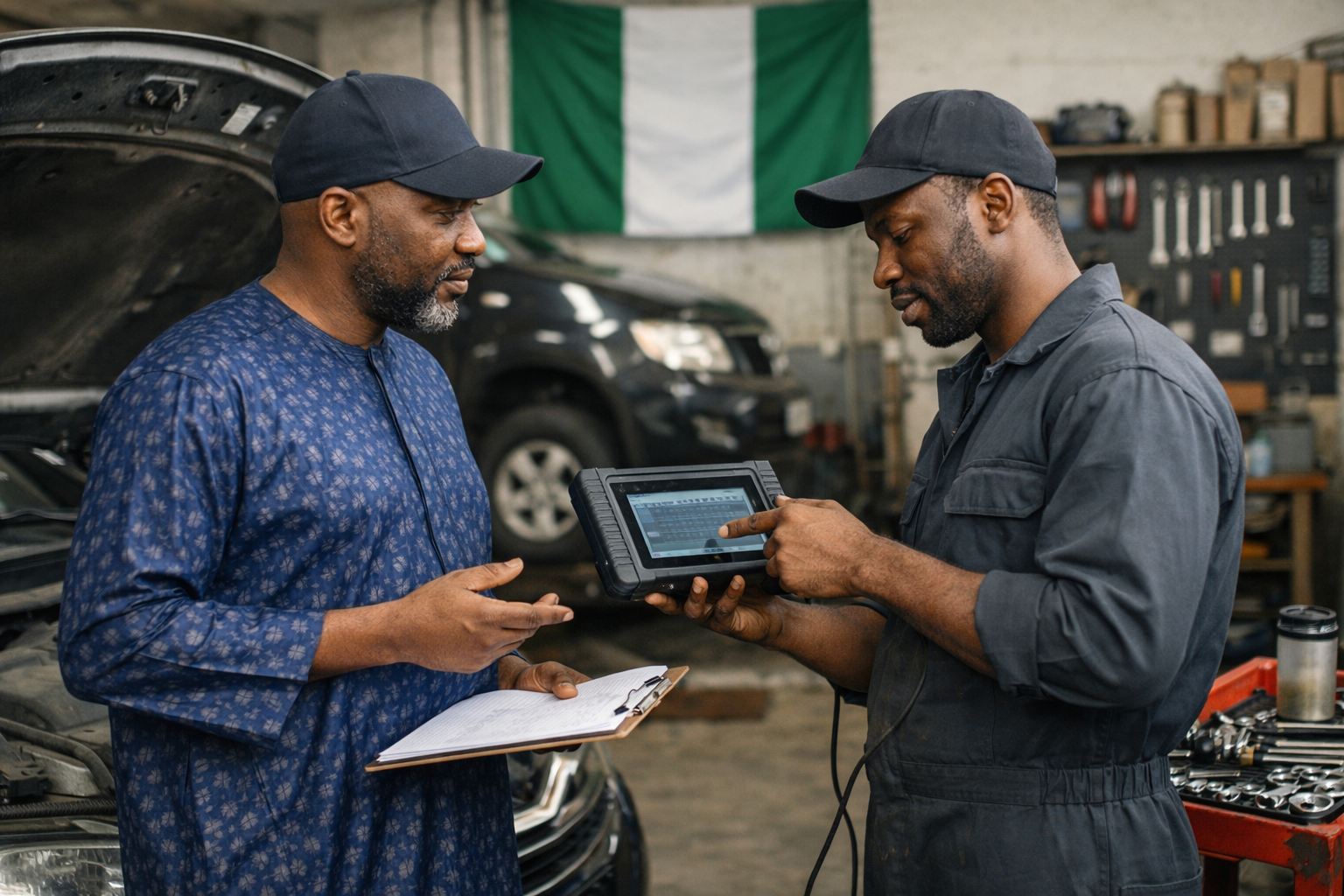
- Precise diagnosis (e.g., scan-tool confirmation of ECU faults) vs. guesswork
- Measured or genuine parts vs. “close-enough” improvisation
- Root-cause fixes vs. band-aid “recycles” that fail in Lagos traffic
Ignore this, and a ₦50,000 brake job can balloon into ₦500,000 when ABS modules fail due to poor wiring.
You Don’t Need Fancy—You Need Reliable
Forget the myth of the “perfect” mechanic. Skip:
- Overpriced “executive” workshops with empty bays
- Shops chasing dealer-level gadgets they barely understand
- Tool hoarders without diagnostic discipline
Instead, prioritize these essentials:
- Boundary awareness: Will say, “My setup can’t handle your BMW’s CAN bus—see a specialist.”
- Fault verification: Scans or tests before swapping parts (Bosch studies show this cuts misdiagnosis costs by ~40%).
- Tool discipline: Correct gauges for alignment, torque wrenches for bolts—every time.
- Transparency: Clear cost breakdowns—diagnosis (₦5,000–₦10,000), parts, and labor—upfront.
One honest “no” from a mechanic once saved me ₦300,000 on a phantom transmission issue later traced to a cheap sensor.
Why Act Now: Nigeria’s Car Crisis Is Accelerating
Nigeria’s roads are filling with:
- Tech-heavy imports: ~80% used vehicles from the US/Europe (NADDC 2025), packed with ECUs, TPMS, and ADAS
- Rising repair costs: Parts up ~150% since the 2023 fuel subsidy removal; electronic fixes can exceed ₦1m
- Stagnant workshops: Many still rely on 1990s multimeters for 2020s vehicle complexity
The technology-repair gap is widening fast—unless car owners demand better.
Lessons from the Road: Misunderstanding Equals Expense
After years of owning and dissecting cars in Nigeria, one truth stands out: problems escalate not because they’re complex, but because they’re misunderstood.
- No scan tool → intermittent faults missed
- No service data → over-torqued bolts, cracked housings
- No accountability → endless “trial-and-error” billing
Awareness changes everything. Start by insisting on diagnostic proof.
How Platforms Like Autolabari Drive Real Change
Individual mechanics can’t fix systemic gaps alone—ecosystems can:
- Information hubs: Ratings, fault histories, verified toolsets
- Clear pricing: Diagnosis separated from parts and labor
- Trust layers: Certifications, service records, owner reviews
When owners are informed, good workshops rise and poor ones fade. Autolabari enables this—quietly, workshop by workshop.
References & Deeper Dives
Grounded in global and local standards:
- OEM systems: Toyota TIS, Honda Service Express, Mercedes-Benz WIS
- Diagnostics: Bosch Automotive Aftermarket guides; root-cause studies (≈30% misdiagnosis rates in emerging markets)
- Standards: ISO 11898 (CAN bus), NADDC policies, SON frameworks
- Nigeria-specific: Automotive aftermarket reports (2024–2025)
For more detail, explore NADDC publications and SON guidelines.
Final Word
Experience without tools breeds overconfidence.
Tools plus process deliver results.
Nigerian car owners deserve reliable repairs—not educated guesses.
Demand better.