
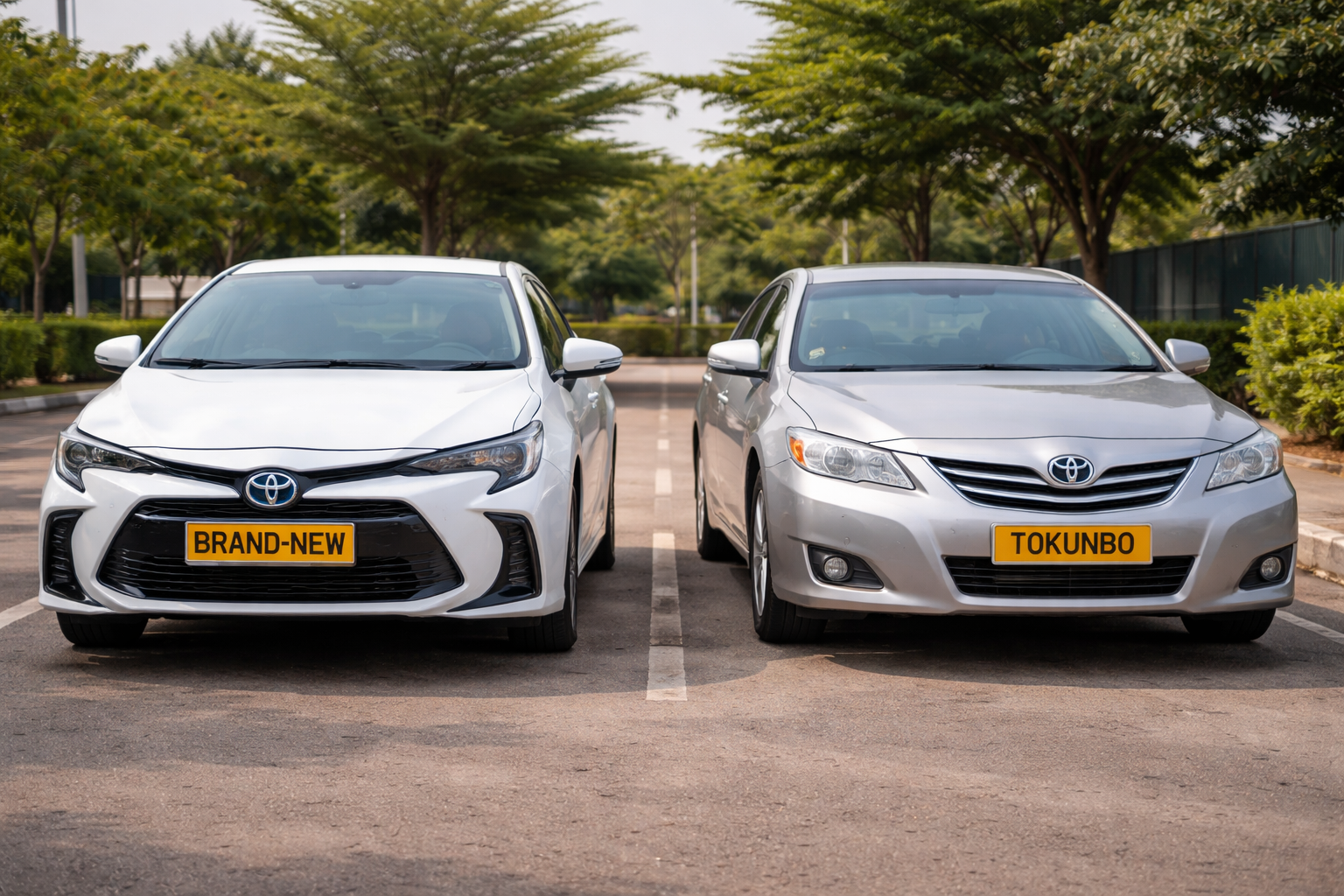
In Nigeria, buying a car is no longer just about preference — it’s about survival economics. With rising vehicle prices, volatile exchange rates, and high maintenance costs, choosing between a brand-new car and a Tokunbo (imported used) car can determine whether car ownership becomes a blessing or a burden.
But first, let’s be clear:
Tokunbo ≠ Nigerian-Used
This article compares Brand-New cars with Tokunbo (imported used) cars only.
What Exactly Is a Tokunbo Car?
A Tokunbo car is a vehicle that:
- Was previously used outside Nigeria (USA, Canada, Europe)
- Is imported into Nigeria
- Is registered in Nigeria for the first time after importation
It is not a Nigerian-used car.
1. Purchase Price: The Real Nigerian Market (2025–2026)
🚗 Brand-New Cars (Popular Brands)
In today’s Nigerian market, brand-new cars from popular manufacturers such as Toyota, Honda, Hyundai, Kia, and Nissan are priced as follows:
- Entry-level economy cars: ₦12m – ₦20m
- Popular sedans & compact SUVs (Corolla, Civic, Elantra, etc.): ₦20m – ₦40m+
- Mid-size SUVs & higher trims: ₦45m – ₦70m+
Anything significantly cheaper usually involves:
- Very basic trims
- Less mainstream brands
- Limited after-sales support
🚙 Tokunbo (Imported Used) Cars
Tokunbo cars still offer a lower entry point — but prices have risen sharply in recent years.
- Older imports (early–mid 2000s): ₦7m – ₦10m
- Mid-range imports (2010–2014): ₦10m – ₦15m
- Newer imports (2015–2019): ₦15m – ₦22m+
Below ₦7m, buyers should expect:
- Very old vehicles
- High mileage
- Possible accident or flood history
2. Depreciation: Where Brand-New Cars Lose the Most
Depreciation is the silent cost many Nigerian buyers ignore.
- Brand-new cars lose about 20–25% of their value in the first year
- After that, depreciation continues at 10–15% annually
Tokunbo cars:
- Have already absorbed the biggest depreciation hit abroad
- Lose value more gradually in Nigeria
👉 Financial insight:
If you plan to resell within 3–5 years, Tokunbo cars usually offer better value retention relative to purchase price.
3. Maintenance & Reliability: Predictability vs Probability
✅ Brand-New Cars
Advantages
- Manufacturer warranty (3–5 years)
- Minimal repairs in early ownership
- Predictable servicing costs
Disadvantages
- Higher purchase price
- Expensive repairs once warranty expires
- Some spare parts may be costly or scarce initially
⚠️ Tokunbo Cars
Advantages
- Lower purchase cost
- Widely available spare parts for popular models
- Often cleaner interiors and less suspension stress than Nigerian-used cars
Risks
- Possible accident or flood history
- Unknown maintenance culture abroad
- Quality depends heavily on inspection and verification
A poorly inspected Tokunbo car can erase its price advantage within one year.
4. Fuel Economy & Daily Running Costs
Newer cars benefit from:
- Improved engine efficiency
- Better transmission systems
- Lower emissions and fuel consumption
Typical comparison:
- Older Tokunbo sedan: ~11–12 km/l
- Newer brand-new model: ~15–17 km/l
With Nigeria’s fuel price volatility, this difference can translate to hundreds of thousands of naira saved annually.
5. Insurance, Documentation & Compliance
- Brand-new cars
- Higher insurance premiums (3–6% of vehicle value annually)
- Cleaner documentation and easier registration
- Tokunbo cars
- Lower insurance premiums
- Require careful documentation checks
- VIN verification is essential
6. Resale & Exit Strategy
Smart buyers plan their exit before entry.
- Brand-new cars depreciate faster early on
- Tokunbo cars often resell faster if priced correctly
- Popular brands (Toyota, Honda) always have stronger resale demand
If flexibility matters, Tokunbo often wins.
So, Which One Makes Financial Sense in Nigeria?
✅ Tokunbo Makes Sense If:
- Your budget is below ₦20m
- You plan to resell within 3–5 years
- You inspect properly and verify history
- You want maximum value for money
✅ Brand-New Makes Sense If:
- You can comfortably afford ₦25m+
- You want warranty and predictability
- You plan long-term ownership (7–10 years)
- You value peace of mind over initial cost
The Autolabari Viewpoint
The smartest Nigerian car owners don’t argue about “Tokunbo vs New.”
They ask:
Which option will cost me less over time, not just today?
That’s why Autolabari Auto Hub focuses on:
- Buyer education
- Vehicle verification
- Trusted service and maintenance connections
Because the most expensive car in Nigeria is not brand-new or Tokunbo —
👉 it’s the one you buy without proper information.
Final Thought
In today’s Nigeria, Tokunbo cars still make financial sense for most buyers — but only when bought intelligently. Brand-new cars offer comfort and certainty, but at a premium that not everyone needs to pay.
The real risk isn’t Tokunbo.
The real risk is buying blind.